
Autism Spectrum Disorder (ASD) and Its Comorbidities: Diagnosing and Management for Primary Care Providers
AUTHORS:
Ruchita Kachru, MD1; Mary Valletta, MD1; Bilal Khodr, MD1; David Matsibekker, MD1; Sanjeev Tuli, MD2
1Department of Pediatrics, University of Florida, Gainesville, FL
2Department of Pediatrics, University of Texas Medical Branch, Galveston, TX
REVIEW ARTICLE | PUBLISHED Summer 2026 | Volume 46, Issue 3
DOWNLOAD PDF
Introduction
Autism Spectrum Disorder (ASD) is a complex and lifelong neurodevelopmental condition that affects individuals in varied and often profound ways. Characterized by impairments in social communication and restricted, repetitive behaviors, ASD is frequently accompanied by a range of comorbid conditions that exacerbate its impact on individuals and families. The increasing prevalence of ASD, along with the growing recognition of its comorbidities, underscores the need for primary care providers (PCPs) to take a more active role in diagnosing and managing the disorder.
Recent studies indicate that the prevalence of ASD has risen dramatically, with the Centers for Disease Control and Prevention (CDC) estimating that 1 in 36 children in the United States have ASD, according to 2020 data from the Autism and Developmental Disabilities Monitoring (ADDM) Network.1 This represents an increase from previous estimates, reflecting not only a true rise in cases but also improved awareness, better screening, and expanded access to diagnostic services. The male-to-female ratio for ASD remains approximately 3.7 to 1, with boys being more frequently diagnosed than girls.2,3
Recent data also show a shift in the racial and ethnic distribution of ASD diagnoses. Historically underserved communities, particularly Asian Pacific Islander populations, have seen higher rates of ASD diagnoses in part due to improved screening practices and greater access to healthcare services. However, significant regional disparities in access to care remain, particularly in rural areas. For instance, a 2026 analysis by Twelve Oaks Psychiatry of Florida Department of Health licensure data found that 18 of Florida’s 67 counties have no psychiatrist.4 This shortage of specialists places additional pressure on primary care providers to manage both the primary disorder and its comorbidities.
In addition to the core symptoms of ASD, comorbid conditions such as attention-deficit/hyperactivity disorder (ADHD), anxiety, epilepsy, and learning disabilities are highly prevalent and can significantly affect the quality of life of individuals with ASD. Understanding these comorbidities, along with current diagnostic and therapeutic strategies, is essential for PCPs to provide comprehensive care to these patients.
Understanding ASD
ASD is a neurodevelopmental disorder that impacts communication, social interaction, and behavior. It manifests on a continuum, with individuals exhibiting a broad range of severity in symptoms. The diagnosis of ASD is based on the criteria in the Diagnostic and Statistical Manual of Mental Disorders, Fifth Edition (DSM-5). These criteria emphasize two primary domains:
- Persistent deficits in social communication and social interaction: Difficulty with verbal and nonverbal communication, challenges in initiating and maintaining conversations, and an inability to engage in reciprocal social interactions.
- Restricted, repetitive patterns of behavior, interests, or activities: Repetitive movements, rigid adherence to routines, intense focus on specific interests, and sensory sensitivities.
The presentation of ASD can vary widely among individuals, making diagnosis challenging. In some cases, ASD may present in a highly visible manner, such as when a child avoids eye contact or exhibits repetitive behaviors. In others, symptoms may be subtle and harder to identify, making early diagnosis and intervention critical.
Diagnostic Criteria and DSM-5 Changes
The DSM-5 consolidated several disorders from the DSM-IV, including Asperger’s Syndrome, Pervasive Developmental Disorder-Not Otherwise Specified (PDD-NOS), and Childhood Disintegrative Disorder, under the umbrella of ASD. The DSM-5 also introduced new guidance on the role of sensory processing issues, which are common but often overlooked in clinical practice.
While the DSM-5 provides a standardized diagnostic framework, the heterogeneity of ASD means that no single clinical presentation fits all individuals. Children with ASD may exhibit a wide range of intellectual and language abilities, from nonverbal children with profound intellectual disabilities to high-functioning individuals with above-average intelligence.5
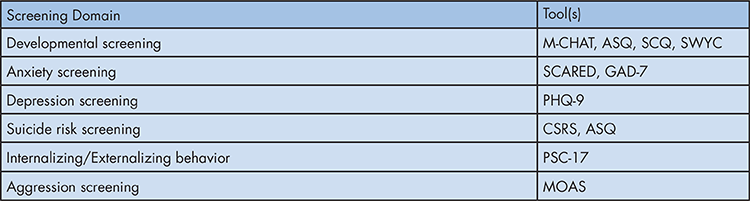
Table 1: Common behavioral and mental health screeners used in primary care pediatrics Footnotes (Abbreviations): • M-CHAT = Modified Checklist for Autism in Toddlers • ASQ (developmental) = Ages & Stages Questionnaires • ASQ (suicide) = Ask Suicide-Screening Questions • SCQ = Social Communication Questionnaire • SWYC = Survey of Well-being of Young Children • SCARED = Screen for Child Anxiety Related Emotional Disorders • GAD-7 = Generalized Anxiety Disorder, 7-item scale • PHQ-9 = Patient Health Questionnaire, 9-item scale • CSRS = Columbia Suicide Severity Rating Scale (often written as C-SSRS) • PSC-17 = Pediatric Symptom Checklist–17 • MOAS = Modified Overt Aggression Scale
Comorbidities in Autism Spectrum Disorder
Comorbidities are defined as conditions that exist simultaneously with ASD, and they can significantly complicate diagnosis and treatment. The Swedish twin study, which interviewed 9-year-old twins born between 1992 and 2001, found that 50% of children with ASD had four or more co-occurring psychiatric disorders.6 A more recent cohort study involving 42,564 children with ASD found that 74% of these children had at least one comorbidity, and 50% had more than four coexisting conditions.7 The most common comorbidities in children with ASD in the analysis included:
- Developmental coordination disorders: 87-88%
- Sensory processing disorder: 70-90%
- Sleep-wake problems: 36-50%
- ADHD: 28-46%
- Anxiety: 30-39%
- Intellectual disabilities: 26-41%
- Motor problems: 19-64%
- Feeding and eating disorders: 20-46%
- Disruptive behavior: 21-36%
- Depressive disorders: 15-21%
- Specific learning disorders: 8-20%
- Seizure disorders (epilepsy): 20-30%
Each of these comorbidities poses unique challenges and requires specific management strategies. Notably, children with ASD experience a higher burden of medical and psychiatric comorbidities compared to their neurotypical peers. This necessitates regular screening (Table 1) and individualized treatment plans.8
Common Comorbidities in ASD and Current Management
- Attention-Deficit/Hyperactivity Disorder
ADHD is one of the most common comorbidities in ASD, affecting up to 50% of children with ASD. Symptoms of ADHD, such as inattention, hyperactivity, and impulsivity, overlap with ASD symptoms but are treated differently. Accurate diagnosis requires a comprehensive assessment, including behavior observation across multiple settings and a psychoeducational evaluation.
- Medication management: Stimulant medications (e.g., methylphenidate) are often effective but may have heightened side effects in children with ASD. Non-stimulant medications, such as alpha-2 adrenergic agonists (e.g., guanfacine and clonidine), are alternative treatments.
- Additional management: Behavioral interventions, including parent management training and cognitive-behavioral therapy (CBT), can help address symptoms of ADHD.
- Anxiety and Depression
Anxiety and depression are common among individuals with ASD but are often underdiagnosed due to the overlap with ASD symptoms. Children with ASD may have difficulty articulating their feelings of anxiety, which can manifest as irritability, withdrawal, or increased repetitive behaviors.
- Anxiety: Cognitive-behavioral therapy (CBT) is effective for children with ASD. Medications such as selective serotonin reuptake inhibitors (SSRIs) are also used, although caution is needed due to the potential for side effects. Escitalopram is currently approved by the U.S. Food and Drug Administration (FDA) for use in children with anxiety aged 7 years and older.
- Depression: Depression is more difficult to detect in children with ASD, but screening tools like the Patient Health Questionnaire (PHQ-9) and the Columbia Suicide Severity Rating Scale can aid in diagnosis. SSRIs, such as fluoxetine and sertraline, may be prescribed, starting at the lowest dose and titrated slowly.
- Epilepsy
Seizures are common in individuals with ASD, affecting about 20-30% of children with the disorder. Seizures tend to present in early childhood or adolescence and are more common in those with intellectual disabilities or nonverbal communication. If seizures are suspected, an electroencephalogram should be performed. Genetic testing may provide additional insights into potential underlying syndromes.
- Treatment: Antiepileptic drugs (AEDs) are used to manage seizures. Lamotrigine is often preferred due to its favorable side-effect profile, though other AEDs may be necessary based on seizure type.
- Learning Disabilities
Learning disabilities are present in a significant portion of individuals with ASD. These include difficulties in reading, writing, math, and executive functioning. Psychoeducational evaluations are essential to identify specific learning challenges and develop appropriate educational plans.
- Educational Support: Individualized Education Plans (IEPs) or Section 504 Plans are used to provide accommodations in school settings, including modified curricula, extended testing time, or behavioral interventions.
- Therapeutic Interventions: Speech therapy, occupational therapy, and other related services can support children in developing functional skills.
- Sleep Disorders
Sleep problems are prevalent in children with ASD, including difficulties with sleep onset, sleep maintenance, and early awakening. These issues can exacerbate behavioral problems and affect daytime functioning.
- Behavioral Interventions: Establishing a consistent bedtime routine and limiting stimulating activities before bed can improve sleep hygiene.
- Pharmacological Interventions: Melatonin, a hormone that regulates the sleep-wake cycle, is frequently used to address sleep disturbances in children with ASD.
A Multidisciplinary, Individualized Model
Managing ASD requires a holistic approach that integrates medical, behavioral, educational, and psychological interventions. Regular follow-up and routine screenings for comorbid conditions are essential. Given the complexity of ASD and its comorbidities, PCPs should work closely with specialists in pediatric neurology, psychiatry, psychology, and occupational therapy to provide comprehensive care. In addition, parents and caregivers must be actively involved in the treatment process, as they play a crucial role in the implementation of interventions.9
Conclusion
Autism Spectrum Disorder is a complex, multifaceted condition that requires early diagnosis and ongoing, individualized treatment. With the rising prevalence of ASD and its associated comorbidities, primary care providers must be prepared to recognize and manage these challenges. By adopting a comprehensive, team-based approach, PCPs can significantly improve outcomes for individuals with ASD, enhancing their quality of life and supporting their families.
Author(s) Disclosure Statement: Authors report no conflicts of interest.
References
- Maenner MJ, Warren Z, Williams AR, et al. Prevalence and Characteristics of Autism Spectrum Disorder Among Children Aged 8 Years — Autism and Developmental Disabilities Monitoring Network, 11 Sites, United States, 2020. MMWR Surveill Summ 2023;72(No. SS-2):1–14.
- Mukherjee SB. Autism spectrum disorders—diagnosis and management. Indian J Pediatr. 2017;84(4):307-314.
- Hyman SL, Levy SE, Myers SM; Identification, evaluation, and management of children with autism spectrum disorder. Council On Children With Disabilities, Section On Developmental And Behavioral Pediatrics. Pediatrics 2020;145(1):e20193447.
- Florida Center for Behavioral Health Workforce (FCBHW), University of South Florida — Interactive Data Dashboard (Florida Department of Health active licensure records), data years 2016 and 2026; county-level dataset retrieved July 3, 2026. Available at: https://fcbhw.org/dashboard Accessed July 22, 2026.
- Singhi P, Malhi P. Early diagnosis of autism spectrum disorder: what the pediatricians should know. Indian J Pediatr. 2023;90(4):364-368.
- Lundström S, Reichenberg A, Melke J, et al. Autism spectrum disorders and coexisting disorders in a nationwide Swedish twin study. J Child Psychol Psych. 2015 Jun;56(6):702-10.
- Micai M, Fatta LM, Gila L, et al. Prevalence of co-occurring conditions in children and adults with autism spectrum disorder: A systematic review and meta-analysis. Neuroscience Biobehav Rev. 2023;155:105436.
- Baumer N, Spence SJ. Evaluation and management of the child with autism spectrum disorder continuum. Child Neurol. 2018;24(1), 248-275.
- Lin X, Wang G, Shen S, Zhan J. Advances in the diagnosis and treatment of autism spectrum disorders in children. Altern Ther Health Med. 2024;30(3):170-175.